
Waterproofing materials and installation systems
Waterproofing Materials and Installation Systems in Canberra
Start with the location, substrate, water exposure and complete installation system. A shower, tiled balcony, exposed roof and soil-retaining wall can need different materials and detailing. This guide explains the choices to discuss in an assessment and written quote.
Materials, sheet membranes and installation checks
Choose materials by location, substrate and exposure; understand sheet, PVC, TPO and polymer-cement systems before agreeing to the work.
Bathroom Waterproofing & Retiling · Balcony Waterproofing & Leak Repairs · Roof Membrane Waterproofing & Leak Repairs · Retaining Wall Waterproofing
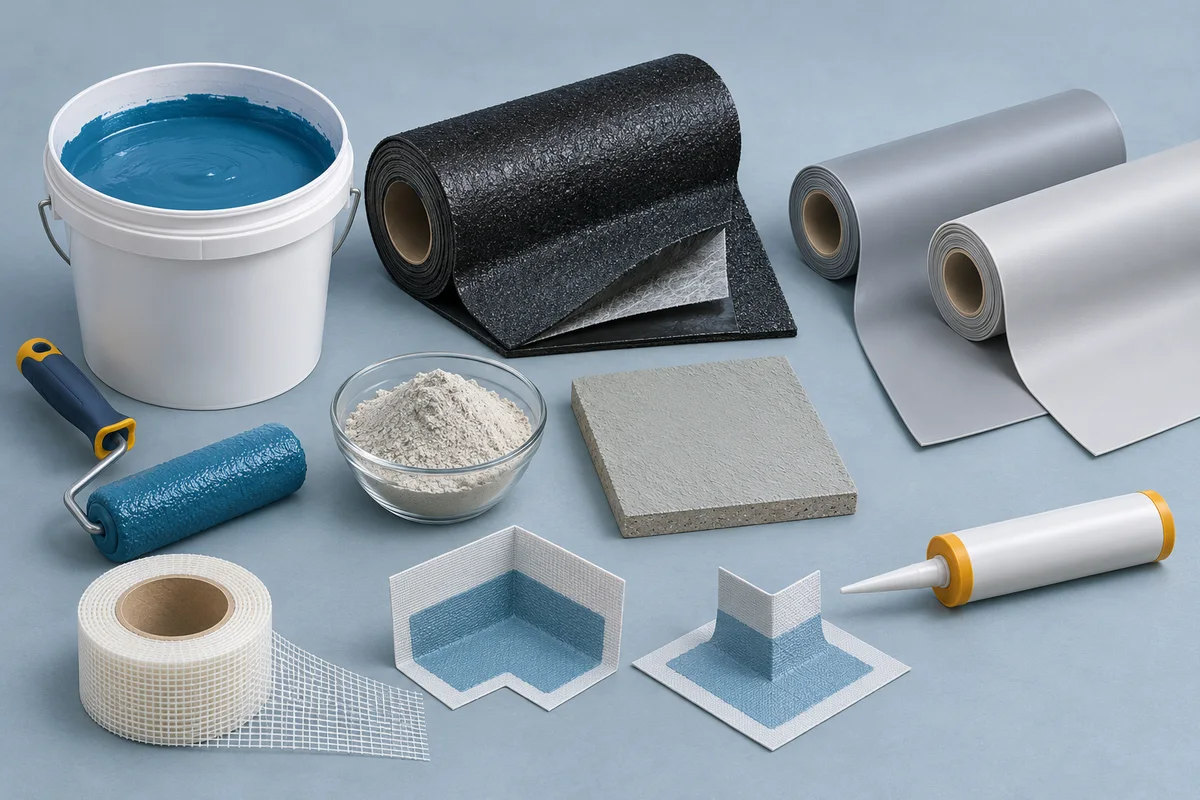
Match the waterproofing system to the building part
For showers, bathrooms and laundries, consider a system documented for the wet-area substrate and intended tile or screed finish. Suitable liquid membranes and dedicated under-tile sheets are alternatives; neither product form is automatically right for every room.
A tiled balcony needs external under-tile suitability, drainage falls and continuous details at outlets, thresholds and wall junctions. An exposed roof needs a system designed for weather and UV exposure, with compatible terminations and the specified protection. A membrane designed to be covered is not automatically an exposed-roof finish.
We assess retaining walls, pools and tanks for the water pressure, substrate, access and drainage conditions involved. The waterproofing plan combines a suitable complete system with the joint details, protection and backfilling or immersion requirements for that location. We consider corners, penetrations, construction joints and the protection needed before the area is covered, backfilled or put into service.
Sheet membranes: roofs, under tiles and below ground
Sheet describes a factory-made form, not one chemistry or one installation method. Modified bitumen, synthetic rubber, PVC and TPO sheets have different roles. ARDEX WPM 185 is a mineral-faced APP modified-bitumen cap sheet for exposed roof or deck systems; it is not a generic bathroom liner. Some bituminous sheets are torch-applied and others self-adhesive, so even the fixing method must be selected by model.
Dedicated under-tile sheets also exist. ARDEX WPM 750 is specified for internal tiled wet areas and uses heat-welded seams with selected compatible tiling systems. Other sheets can use different jointing methods. The quote should name the sheet, adhesive or fixing, seams, corners, penetrations and connection to the outlet rather than simply state “install a roll”.
PVC and TPO membranes need application-specific detailing
PVC is polyvinyl chloride; TPO is thermoplastic polyolefin, also described as FPO in some technical literature. They are different material families. Selected roofing sheets use hot-air-welded joints and an approved adhered, mechanically fixed or other specified roof build-up. Sarnafil G 410-20 L is one Australian PVC roofing example designed for direct exposure.
Below-ground PVC or FPO systems have their own arrangements for joints, terminations, protection and water pressure. The Sikaplan name covers different product ranges, including roofing and underground applications; the name alone does not establish the use. Confirm the precise model, substrate separation layers, compatibility and seam inspection method. Do not substitute a roof sheet for a shower or basement membrane because all are called PVC.
Polymer-modified cementitious waterproofing
Polymer-modified cementitious membranes combine cement-based materials with polymers to form a waterproofing layer on suitable substrates. They are commonly considered for mineral surfaces such as concrete, render and masonry, with particular products also specified for under-tile areas or immersion. Selection follows the exact product data, substrate and exposure requirements.
Cementitious products can be flexible and can come in one- or two-component forms. Gripset C-1P is a one-component example for specified positive- and negative-pressure applications on suitable mineral substrates. Gripset 2P is a two-component example with documented under-tile, immersed and subterranean uses. Those permissions belong to the individual product: do not transfer them to every cement-based coating or every board substrate.
For a proposed cementitious system, confirm the substrate, movement demands, water-pressure direction, required thickness, curing and compatible covering. Use the supplied components and the nominated mixing procedure. Adding extra cement, water or an unrelated polymer changes the specified system.
Water-based and polyurethane liquid membranes
Water-based describes the carrier; polyurethane or acrylic describes chemistry. These categories can overlap: ARDEX WPM 155 Rapid Plus is a water-based polyurethane-acrylic hybrid intended for under-tile waterproofing. Gripset 38FC is a water-based SBR latex membrane used under specified coverings. The product data must establish outdoor use, covering requirements and substrate compatibility; “water-based” does not mean indoor-only.
Polyurethane is not automatically a complete UV-resistant roof system. Sikalastic-488 is a polyurethane base membrane; the SikaRoof MTC-12 UV system pairs it with a specified topcoat. An exposed-roof proposal must identify the complete build-up, any reinforcement, UV protection, permitted traffic and maintenance access. A product that tolerates rain is not necessarily suitable for permanent immersion.
Bitumen, epoxy and crystalline waterproofing systems
Liquid bitumen-rubber membranes differ from bituminous sheets. Gripset 51 is a liquid example for specified retaining-wall and underground uses; its documentation warns about long-term UV exposure. For a buried membrane, protection from backfill damage and the drainage design need separate attention. A coating does not correct structural movement or replace drainage work.
An epoxy barrier can have a different role from the flexible main membrane. ARDEX WPM 300 is an epoxy primer/barrier coating with specified moisture-control and pressure-resistant uses. It is not epoxy tile grout, and its role in a wet-area build-up must be identified rather than assumed. Xypex crystalline treatments work with suitable concrete; they are not a universal flexible covering for timber, board joints or moving cracks.
Waterproofing installation: checks before covering
ARDEX STB and STA illustrate the role of compatible detailing accessories: a butyl tape or sheet can form part of a nominated membrane junction system. It is not automatically a stand-alone membrane or an exposed finish. Check the specific membrane pairing rather than assuming any tape and liquid coating can be combined.
Assessment and preparation: establish the water source or new installation requirement, substrate stability, moisture condition and falls. Remove unsuitable coatings and repair the substrate as specified. Some systems require a dry base; others allow defined damp conditions. “Damp-compatible” does not mean application over flowing water or any wet surface.
Primer and details: use the specified primer where required. Complete the nominated corners, bond-breaker or joint-band arrangement, pipe collars, waterstops, outlets and terminations. A bond breaker is a movement detail within a system, not simply another name for the visible silicone joint. Follow the selected system rather than automatically adding the same tape and sealant everywhere.
Membrane installation: liquid systems need the specified coverage and wet/dry film thickness, without pinholes or unapproved thinning. Sheets need the specified support, adhesion or fixing, jointing and edge treatment. Hot-air welding, torch application and self-adhesive installation are different processes; require the appropriate installer, safety controls and system instructions. Do not use a generic welding temperature or lap dimension across products.
Curing, inspection and protection: distinguish recoat time, tiling time, testing time and return-to-service time. Temperature, humidity and the selected product affect these stages. Record membrane coverage or thickness checks and sheet-seam checks before covering. Any flood or other water test must suit the structure and system, occur after the required cure and be agreed in advance; it is not a DIY leak-finding exercise. Protect the finished membrane during tiling or backfilling.
Material selection and waterproofing quote records
Our written proposal identifies the location, area, substrate preparation, exact products, primer, membrane, reinforcement, junction accessories, outlets and terminations. We also explain protection, tiling, checks and the sequence through to completion. Our team plans these components as one installation, with the selected coverage, thickness, seam and curing requirements recorded for the work.
For Canberra projects, our team checks the applicable NCC edition, ACT requirements and project approvals when planning the work. We match the system to the wet-area or external location and review the current Australian product data, installation instructions and project records. Your written plan identifies preparation, junctions, protection and the completion information relevant to the installation.
MEL ONE selects waterproofing materials and installation methods to suit your property. We explain the recommended system and confirm the product, preparation, installation details and the related repair and finishing work in your written quote. Your proposal explains why the system suits the location, how our team will install it and what protection, curing and maintenance the finished area needs.
Material and waterproofing system questions
Where are sheet waterproofing membranes used?
There are sheets for exposed roofs, internal under-tile wet areas and below-ground structures, but they are different systems. Select by exact product, substrate and exposure. For example, an APP roof cap sheet is different from a dedicated under-tile sheet. Seams, corners, outlets, fixing and protection are part of the specification; a roll of material alone is not a complete waterproofing system.
Can PVC or TPO roof membrane be used in a shower?
A roofing designation does not establish under-tile wet-area suitability. PVC and TPO are different material families, and roof, basement and under-tile products have different build-ups and joint details. Use a product explicitly documented for the intended wet-area substrate and tile finish, with its compatible adhesive and outlet details. The polymer name is not a substitute for the specific system instructions.
Where is polymer-modified cementitious waterproofing usually used?
These systems are commonly considered for concrete, render and masonry. Particular products are documented for wet-area tiling, underground walls or immersion, and some systems suit negative-side water pressure. The proposed product is checked against the substrate, movement and exposure, together with its specified preparation, thickness, joint treatment and curing.
Can a water-based waterproofing membrane be used outside?
Some products can, subject to their documented external use, substrate and covering requirements. Water-based describes the carrier, not the exposure rating. An external under-tile membrane may still need tiles or another specified cover and may not be suitable as an exposed roof finish. Confirm UV exposure, ponding, immersion and traffic separately rather than assuming all outdoor conditions are equivalent.
Does polyurethane waterproofing need a UV-resistant topcoat?
It depends on the exact product and complete exposed-roof system. Some polyurethane base membranes require a specified protective topcoat; others have different exposure instructions. Sikalastic-488 and the SikaRoof MTC-12 UV build-up illustrate why the base membrane and the whole system must be distinguished. Confirm the nominated layers and maintenance requirements instead of treating every PU coating as a finished roof surface.
Is an epoxy moisture barrier the main flexible waterproofing membrane?
Not automatically. A product such as ARDEX WPM 300 has specified primer and barrier roles, including certain moisture and pressure conditions. Its position in the selected build-up needs to be stated. It is different from epoxy tile grout and does not automatically replace the flexible membrane, joint detailing or compatible tiling system required for the wet area.
Does two coats prove the correct waterproofing thickness?
Coat count alone is not enough. Liquid membranes have product-specific coverage and wet or dry film requirements, together with preparation, detailing and cure conditions. A sheet has a manufactured thickness, but its seams and terminations still need the specified installation and checks. The quote and records should identify the selected system and relevant checks, not a universal number of coats or drying hours.
Can balcony waterproofing be used for a pool or retaining wall?
We select waterproofing systems for the application, including balconies, pools, tanks and retaining walls. For permanent immersion or water pressure, we check the exact product, substrate, joints, protection and drainage requirements together before specifying the installation. Our team specifies the primer, membrane, junction accessories and protective finish as a connected system, with preparation and curing planned for the actual location.
Manufacturer documentation for waterproofing materials
Manufacturer examples reviewed for this guide: ARDEX WPM 155 Rapid Plus, WPM 185, WPM 750 and WPM 300; Gripset 38FC, C-1P, 2P and 51; Sika Sarnafil G 410-20 L, Sikaplan ranges, Sikalastic-488 and SikaRoof MTC-12 UV; Xypex concrete treatments. Check the current Australian data for the exact proposed system.
Our team uses Australian manufacturer instructions, ACT building requirements and wet-area guidance to plan the selected system. We explain the products and installation stages for your property, including preparation, junction treatment, curing, protection and finishing, before the work begins.
Waterproofing & Retiling Quote Guide · Waterproofing or Drainage Guide
Arrange an on-site assessment and written quote for the waterproofing required at your property.
See these systems in the context of the roof sheet membrane work record alongside the documented commercial roof work record. They illustrate work locations and installation details; the specified product and complete system still belong in each written scope.
For flexible surface joints rather than a sheet or liquid membrane, see laundry silicone resealing record and scope. Joint sealing and renewal of a concealed membrane are different work items.